
1. SOLUTION OVERVIEW
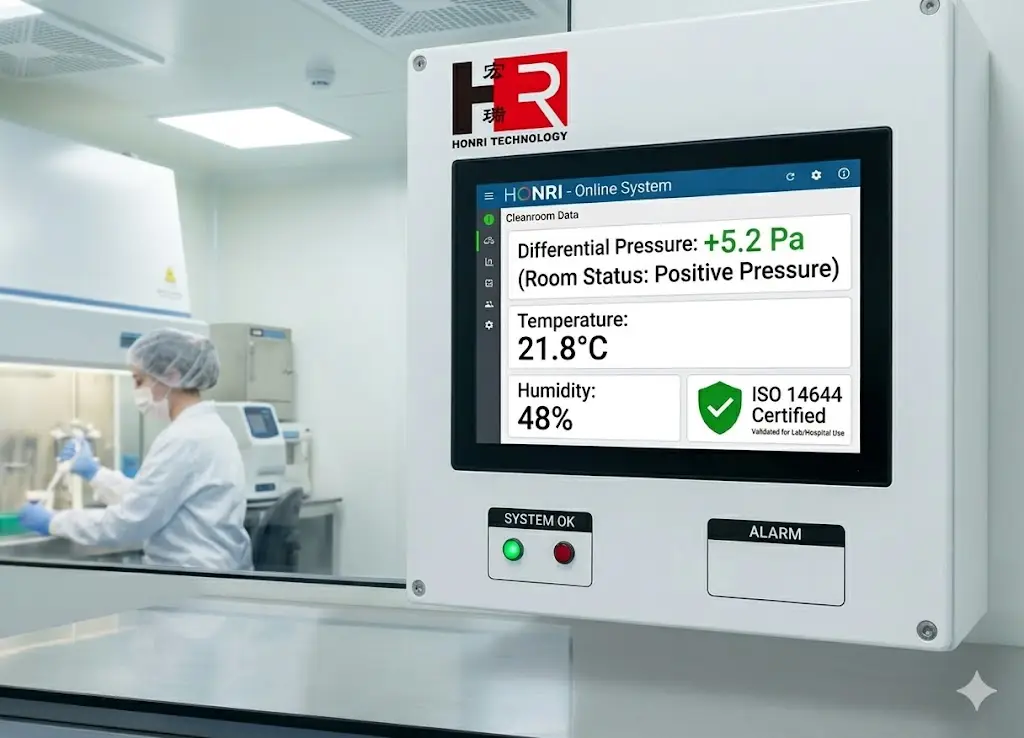
The HR-FMS Online Monitoring System by Honri Purification is specifically designed for high-risk areas such as operating rooms, ICUs, negative pressure isolation wards, PCR laboratories, biosafety labs, and sterility testing rooms. The system provides 7×24H automated online monitoring of suspended particles, viable organisms, temperature, humidity, differential pressure, air velocity, illuminance, and chemical pollutants (TVOC).
2. CORE DESIGN PRINCIPLES
2.1 Risk-Based Classification & Sampling Design (ISO 14644-1)
-
Zoned Monitoring Strategy: Differentiated monitoring plans are implemented for areas with different risk levels, such as Operating Rooms (ISO Class 5), PCR Lab Amplification Zones (ISO Class 7), and ICUs (ISO Class 6).
-
Sampling Location Calculation: For high-risk areas, the minimum number of sampling locations (NL) is calculated strictly using the standard formula:
NL = √A
Parameters:
NL: Minimum number of sampling locations (rounded up to the next whole number).
A: Cleanroom area (Unit: m²).
-
Priority for Critical Workstations: At least one monitoring point is placed at core exposure areas such as directly above the operating table, sample processing benches, and aseptic filling stations.
-
Standardized Positioning: Sampling probes are set at a uniform height of 0.8–1.2 m; locations must be ≥ 30 cm from walls and ≥ 1 m from HEPA filters to ensure representative data.
2.2 Airflow & Microbial Control (ISO 14644-4 / ASHRAE 170)
-
Isokinetic Sampling: Probes in unidirectional flow areas (e.g., laminar flow ORs) must be equipped with isokinetic sampling heads to match the air velocity of 0.36–0.54 m/s.
-
Pressure Gradient Specifications: Ensures a differential pressure of ≥ 15 Pa between clean and non-clean zones, and ≥ 5 Pa between zones of the same grade to effectively prevent cross-contamination.
2.3 Data Compliance & Traceability (21 CFR Part 11)
-
Audit Trail: The system logs all parameter modifications, alarm acknowledgments, and data exports, ensuring the data is authentic, tamper-proof, and traceable throughout its lifecycle.
3. CORE HARDWARE CONFIGURATION
| Parameters | Recommended Model | Key Specifications | Compliance Standards |
|---|---|---|---|
| Airborne Particles | CLJ-R210 | 2.83 LPM flow rate; monitors 0.3/0.5/5.0 μm | ISO 14644 / EU GMP |
| Viable Particles | FSC-R10 | Flow rate up to 100 LPM; efficiency ≥ 98% | ISO 14698 / Grade A < 1 cfu |
| Temp & Humidity | TH-30R / 25 | Temp Accuracy: ± 0.3°C; Humidity: ± 3% RH | ASHRAE 170 Medical Standard |
| Pressure Diff. | DP-30R / 25 | Ranges from 0–± 125 Pa to 0–5000 Pa | ASHRAE 170 / ISO 14644 |
| Air Velocity | WS-30R / 25 | Precise monitoring of 0.36–0.54 m/s flow | ISO 14644-4 |
| Chemicals | MIC600 PID | Monitors TVOC with ppb-level detection limits | ISO 14644-8 |
| Illuminance | LD-20R | Measurement range: 0–200,000 lx | Int’l Hospital/Lab Standards |
4. SOFTWARE SYSTEM CAPABILITIES
-
Multi-Zone & Multi-Standard Monitoring: Displays data grouped by department or lab type; interfaces can be customized for facility management or research oversight.
-
Hierarchical User Rights: Configurable access for Administrators, Department Heads, and Operators with electronic signature support.
-
Intelligent Alerts: Thresholds can be customized per international standards; alerts are sent via local sirens, SMS, and mobile APP notifications.
-
Compliance Reporting: Data is categorized and stored to generate encrypted PDF reports, meeting long-term archival requirements for hospital accreditation.
-
Seamless Integration: Supports RS485, WiFi, and TCP/IP for direct connection to Hospital Information Systems (HIS) or Laboratory Information Management Systems (LIMS).
5. STRATEGIC VALUE
-
International Compliance: Assists hospitals in achieving JCI Accreditation and labs in securing CNAS/ILAC recognition.
-
Precision Risk Control: Real-time monitoring of high-risk parameters reduces post-operative infection rates and sample cross-contamination.
-
Research Quality Assurance: Provides continuous, accurate, and tamper-proof environmental data to support the reliability of scientific results.
-
Energy Efficiency: Aligns with ISO 14644-16 to optimize ventilation system operation based on data analysis, reducing energy costs.
Solution Provider:
Reviews
There are no reviews yet.